
Revenue & Missed Revenue
How RenewMap derives Generation and Load Revenue and Missed Revenue per unit from AEMO's published dispatch prices and loss factors, how missed revenue splits by curtailment cause, and what those dollar figures do and don't include.
Megawatts tell you what a project did. Dollars tell you whether it mattered. Two projects can have identical output profiles and very different revenue, because the NEM’s spot price moves by orders of magnitude within a day: from below zero in the middle of a sunny spring afternoon to thousands of dollars per megawatt hour during a summer evening peak.
Generation Revenue and Load Revenue value a unit’s output and consumption at the price that actually applied, interval by interval, adjusted for the transmission losses between the unit and the point where the price is set. They’re kept separate rather than netted, so a battery’s charging cost doesn’t cancel its discharging revenue.
Missed Revenue applies the same valuation to energy that never happened. It takes the curtailment figure for the same interval and asks what that output would have been worth. This is the number that values curtailment. Ten percent curtailment concentrated in $0/MWh intervals is close to costless.
Because curtailment splits by cause, so does Missed Revenue. Missed Revenue (network) values the energy a binding constraint kept out of the market, and is the closer of the two to a genuine loss: the unit was willing to sell at the price on offer and couldn’t. You’ll occassionally see Missed Revenue (economic) if the renewable generator was bidding above the market price while it was positive.
A short detour on how NEM pricing works
If you’re new to NEM pricing, a quick overview is below:
One price per region, per interval. The NEM has five regions (Queensland, New South Wales, Victoria, South Australia and Tasmania) and each has a Regional Reference Price (RRP) for every dispatch interval. Every generator in a region is paid the same RRP regardless of what it offered; the offer only determines whether it gets dispatched.
Losses are modelled and fixed for the year. The price is set at the Regional Reference Node, and the Marginal Loss Factor determines how much of the generation reaches this point. This is a fixed value set for a year at a time, but is directly used when calculating spot revenue (how much generation to get paid for).
Prices go negative. The floor is −$1,000/MWh. Negative prices happen when there’s more must-run and low-cost generation than demand can absorb, and generators pay to keep producing rather than shut down, a rational choice for a plant with a certificate or contract structure that rewards output. Negative prices are now a routine feature of the middle of the day in high-solar regions, and they’re a major driver of economic curtailment.
Prices spike. The upper limit is the market price cap, in the tens of thousands of dollars per megawatt hour and indexed each year. A handful of intervals can dominate a year’s revenue.
Where you see it in RenewMap
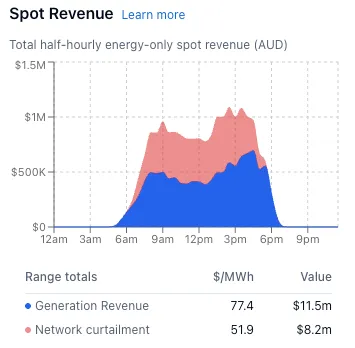
The Spot Revenue chart in a project’s Operational tab, where each component is stacked separately and shown with its implied $/MWh alongside the dollar total, and in the api.
| Granularity | 30 minutes, per DUID |
| Units | AUD ($), a total for the half hour, not a rate |
| Series names | generation_revenue,load_revenue, missed_revenue_constraint, missed_revenue_economic |
| Applies to | Generation Revenue: any unit with a marginal loss factor and generation. Load Revenue: any unit with load. Missed Revenue (network and economic): semi-scheduled units only |
| Blank when | No dispatch or price data exists for the interval, the loss factor hasn’t resolved, or the matching curtailment component isn’t measurable for that unit |
Dollars are summed across intervals and across a date range, rather than averaged like other metrics such as generation or load.
How it’s calculated
Three inputs are needed for each 5-minute slice: the unit’s signed output, the regional price that applied, and the unit’s marginal loss factor. Output is the same figure derived for Generation & Load.
Revenue = output (MW) × marginal loss factor × regional price ($/MWh) × time (h)The half-hourly figures are then summed across whatever date range you’re looking at.
Missed Revenue is the same calculation with curtailed MW in place of dispatched MW, and the price floored at zero. Each component is valued against its own curtailment component, at the same price and the same loss factor.
Four details change how the numbers read:
Generation and Load are valued separately, not netted. Each mirrors its MW counterpart: Generation Revenue values the non-negative Generation series, Load Revenue values the non-negative Load series. A battery charging at 80 MW in a $40/MWh interval is a Load Revenue cost, not a negative Generation Revenue figure, so charging and discharging never cancel out.
Negative prices flow straight through. Generating 100 MW into a −$60/MWh interval produces negative revenue, and that’s not an artefact; it’s what the unit was paid.
Missed Revenue floors the price at zero. Energy curtailed during a negative price interval was worth less than nothing, so counting it as “missed” would be perverse: the curtailment avoided a loss. Flooring the price means Missed Revenue is always zero or positive, and the network component can be read as an upper bound on what better network access would have earned in that interval.
Special notes
This is not settlement revenue, and it is not project revenue. Generation Revenue and Load Revenue are a spot market valuation of dispatched energy and consumption. Real project revenue differs on both sides. This measure does not include:
- power purchase agreements, hedges, caps and swaps
- FCAS and other ancillary service markets, which can be a meaningful earner for batteries in particular
- large-scale generation certificates, Capacity Investment Scheme underwriting, and other policy revenue
- settlement residues, connection point adjustments and the many smaller line items in a real settlement statement
and it excludes all costs: marginal loss on auxiliary load, network charges, market fees, operations and maintenance, and debt service.
Prices are regional, not nodal. The NEM is a regional pricing market: everyone in a region faces the same RRP, and locational differences are handled through loss factors rather than nodal prices. That’s why a constrained-off project can be earning the same headline price as an unconstrained one in the same region while dispatching far less energy.
Interventions use the non-intervention price. When AEMO intervenes in the market (a direction, a reserve contract activation), it publishes both an intervention and a non-intervention pricing run for the affected intervals. We use the non-intervention run, which is also the basis AEMO settles the market on through those periods. Administered price periods and market suspensions are a different mechanism, and those prices appear as published in the archive.
Where the data comes from
Prices are AEMO’s published dispatch prices, used as published. Loss factors come from AEMO’s unit registration data, resolved to the version in force at each interval, and are also shown as a standalone series in each project’s panel. The output valued here is the same telemetry-derived figure used for Generation & Load, and the curtailment that feeds Missed Revenue, including the split between its network and economic components, is derived as described in Curtailment.
Common questions
Is this settlement data?
No. It’s a spot valuation of dispatched energy using AEMO’s published prices and loss factors, applied consistently to every unit.
Does this include PPA revenue, FCAS or LGCs?
No. Only energy in the spot market. See Special notes for the full list of what’s excluded: it’s a long list, and it’s why this metric should never be presented as project revenue.
Why is revenue negative?
Two possible reasons. Either the unit was consuming (a battery charging or a pumped hydro station pumping is buying energy, which is a cost), or it was generating during a negative price interval, in which case it genuinely paid to produce. Both are real market outcomes, not errors. A wind or solar farm may still choose to generate when prices are negative because they have an existing PPA or want to sell the LGCs they’ll generate.
Why is Missed Revenue zero when curtailment was high?
Because the price was at or below zero for those intervals. Curtailed energy is only valued at a positive price; energy foregone at −$50/MWh saved money rather than losing it. This is the most common source of “curtailment looks bad but nothing was lost”, and it’s a useful signal about whether a project’s curtailment is a network problem worth solving.
What is the $/MWh figure next to each component?
The implied price the component realised: dollars divided by the megawatt hours behind them, over whatever period or datapoint you’re looking at. Generation Revenue over generation, and Load Revenue over load, gives the achieved price on each side; each Missed Revenue component over its matching curtailment gives the average price of the energy that didn’t happen. It’s a quick way to see whether curtailment landed in valuable intervals or worthless ones without comparing two charts. These are available as the generation_revenue_price, load_revenue_price, missed_revenue_constraint_price and missed_revenue_economic_price series.
Why does the same project’s revenue jump on 1 July?
Loss factors reset on 1 July each year. If a project’s marginal loss factor moved materially, its revenue per MWh steps at the same date even with identical output and prices.
Does Missed Revenue account for the loss factor?
Yes, the same loss factor is applied to curtailed MW as to dispatched MW, so both series are valued on a consistent basis at the regional reference node.
Related pages
- Curtailment: the network and economic figures that Missed Revenue values
- Generation & Load: the MW figures that Generation and Load Revenue value
- Data sources & coverage: what’s covered, and the update cycle
- Operational metrics overview: how all the metrics fit together